

Streak-Free Interior Car Window Cleaning
Cleaning the inside of your car windows and still seeing streaks — most people know this feeling. The problem isn't with the product, but with three mistakes that almost always happen simultaneously: too much cleaning agent, tap water, and circular wiping motions. This article shows you, step by step, how to achieve lasting streak-free results, without a second attempt.
To clean the inside of your car windows without streaks, you mainly need the right technique: a 1:3 mixing ratio with distilled water, two microfiber cloths, and horizontal wiping motions — nothing more.
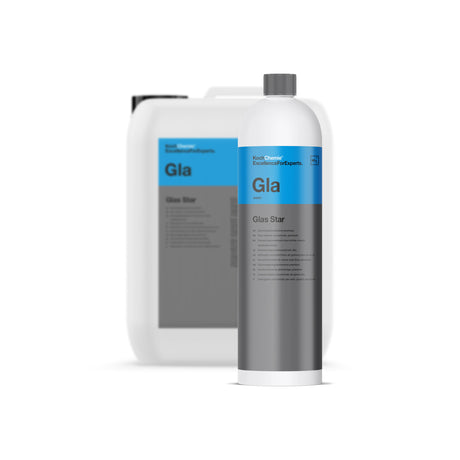
Anyone who has cleaned the windshield three times and still sees streaks when held against the light knows the feeling. The problem is rarely with the product—it's with the method. And as soon as you know the cause, the problem solves itself in two passes. A concentrate like Koch-Chemie Glas Star "Gla" will last you a whole year.
It's not about using more product or rubbing longer. Quite the opposite: those who work with less liquid and a clearly structured technique will have a clear pane after the first pass—and save time and consumption. What exactly is behind this and how you implement it in practice, you can read in the following steps.
The interior window is also more challenging than the exterior window because you are working in a confined space—the steering wheel and air vents make the lower edge of the windshield particularly difficult to access. In addition, the interior is not rinsed with window cleaners and water like the exterior. What builds up stays—until you actively intervene.
What a glass cleaner concentrate for car windows means
The Koch-Chemie Glas Star "Gla" is an alcohol-free glass cleaner concentrate for interior and exterior windows: pH-neutral, low-foaming, and with Daimler approval for contact with vehicle plastics, rubber seals, and haptic surfaces in the interior.
A concentrate is not a pre-mixed product that you spray directly onto the pane. The mixing rule is: 1 part concentrate to 3 parts distilled water — always fill the spray bottle with water first, then add the concentrate. Otherwise, it will foam up when shaken. One liter of concentrate thus yields 4 liters of ready-to-use solution, which is enough for a whole year with weekly care.
Why no alcohol? Alcohol cleans quickly but, in the long run, attacks rubber seals and leaves visible evaporation streaks on large glass surfaces when warm. The Glas Star does without it — and still has strong grease emulsification: fingerprints, nicotine deposits, and oil films from dashboard outgassing become water-soluble and can be removed without residue.
The Daimler approval is relevant in everyday life: it confirms that the product has been officially approved for contact with vehicle interior materials — precisely the surfaces that are inevitably touched during interior cleaning. Anyone cleaning a vehicle with a light dashboard, painted trim, or sensitive plastic haptic surfaces can safely wipe right up to the frame. The slight aniseed smell of the concentrate, which some users notice when opening, is a natural component of the formulation — it evaporates completely with the water content.
Why the interior window always streaks
Streaks on the interior window have three main causes: limescale residues from tap water, overdosed cleaning agent, and the invisible grease film that continuously builds up from dashboard outgassing, finger touches, and air conditioning recirculation.
Tap water contains lime. If you dilute glass cleaner with it or use a damp cloth from the tap, the water leaves visible residues when it dries — especially on the inside of the window, because the air there is particularly dry and warm due to heating and fans. Distilled water costs a few cents per liter at the supermarket or hardware store and completely solves this problem.
Too much cleaning agent on the cloth is the second most common mistake. The bottle lands directly on the pane, too much solution hits a small spot — and wiping doesn't clean, it smears. The result is an even greasy film that becomes immediately visible in backlight. The right amount: 2 to 3 sprays on a medium-sized microfiber cloth, no direct spraying onto the pane.
The third factor is invisible: the oil film. Plastics in the vehicle interior outgas when warm — this is the typical new car smell, but it is also an ongoing process in older vehicles. This film settles on the inside of the window and combines with dust particles. When cleaning for the first time with too little product, it is only spread, not absorbed. The result: a wafer-thin oil film that shimmers in backlight.
And a final factor, which is particularly strong in summer and in direct sunlight: the air conditioning. If it runs during cleaning, it blows dry air against the freshly cleaned pane and dries the film too quickly in certain areas — then islands form. Turn off the AC before cleaning and wait at least 5 minutes before driving off.

Steps 1 and 2: Preparation and Dilution
Before you can clean the inside of your car window, you need two things: the right dilution and the right cloths. Step 1 begins with the spray bottle: 1 part Glas Star to 3 parts distilled water — always water first, then the concentrate. This order prevents foaming during mixing. A 500 ml bottle with 375 ml distilled water and 125 ml concentrate is a good starting volume for a complete interior cleaning.
Then the cloths: Two glass-specific microfiber cloths with a smooth, dense weave, without a terry structure. Cotton and paper towels leave fibers that are visible in backlight. Microfiber cloths with 300 to 450 g/m² in a striped weave are the right material. Two identical cloths from a set make it easier to distinguish: the first cloth cleans wet, the second polishes dry.
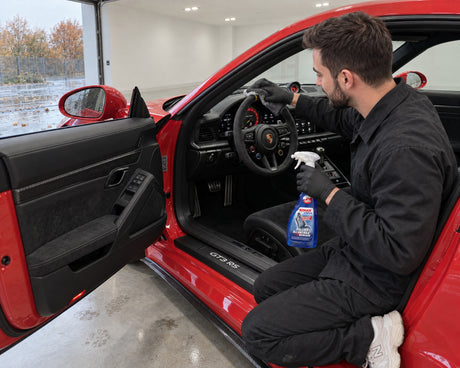
Step 2 is to prepare the cloth: 2 to 3 sprays on the cleaning cloth, not on the pane. The cloth should be evenly damp — not soaking wet, not dry. If you spray directly onto the pane, oversaturation will occur at the point of impact, which will appear as a streak along the lower edge of the pane when wiping.
Before you start: turn off the air conditioning, close the side windows. A good workflow — starting from the passenger side, then the driver's side, finally the windshield from the passenger side — avoids brushing your sleeve over a freshly cleaned surface. For the windshield, a sponge holder or a long cleaning plate helps to reach the lower edge behind the dashboard.
Steps 3 and 4: Cleaning and Polishing
Step 3 is the actual cleaning: Wipe the pane in straight, overlapping strokes from top to bottom — never in circles. Circular motions distribute dirt evenly over the surface instead of picking it up. Light, even pressure across the entire surface is better than heavy pressure on a single spot.
For the rear window, there is an exception: always wipe along the heating elements — i.e., horizontally, never vertically or in circular motions. Heating elements are printed conductor tracks that are mechanically damaged over years by wiping movements across them. A zone in the rear window that no longer heats cannot be repaired — the glass must be replaced.
Step 4 is polishing with the dry second cloth, immediately, while the surface is still slightly damp. If the glass cleaner has dried completely, residues will form. The polishing cloth absorbs this layer. Light pressure with a flat hand, long linear strokes — the dry polishing phase takes hardly longer than the cleaning itself.
The practical test after cleaning: Hold the pane against a side light — a window, a desk lamp, or the low sun from the side. Streaks will be immediately visible. If the surface is clear: done. If there are still streaks — use a fresh dry cloth and polish dry again. More cleaning agent does not help at this stage; a fresh polishing cloth does.

The five most common mistakes when cleaning the inside of the window
Most streaks are caused by five errors that reinforce each other — none of which have anything to do with the quality of the cleaning agent.
Error 1: Tap water. Limescale leaves milky residues, especially visible when looking through the pane against a dark background or in low sun. Always use distilled water for dilution — this also applies to rinsing the cloth after use.
Error 2: Spraying directly onto the pane. The solution hits too concentrated and runs into the lower edge of the pane when wiping. Always spray onto the cloth: 2 to 3 sprays for a side window, 3 to 4 for the windshield.
Error 3: Wrong mixing ratio. 1:3 is optimal. More concentrated mixtures do not clean better — they leave more residues when drying. Users consistently report that Glas Star dries streak-free when dosed correctly — confirmed by verified reviews on Trusted Shops.
Error 4: Circular movements. They distribute dirt instead of picking it up. Horizontal passes from top to bottom — on the rear window along the heating elements, never across them.
Error 5: Air conditioning running. Air circulation dries the cleaning solution too quickly and unevenly and carries dust onto the freshly cleaned surface. Turn off the AC before cleaning, close windows, then clean.
A sixth factor — not a classic error in the stricter sense, but often underestimated in practice: the nicotine film in smokers' vehicles. Nicotine settles as a yellowish, sticky grease film on the inside of the pane, which is not completely dissolved with a single cleaning pass. Recommendation: first pass with a 1:2 mixture (slightly more concentrated than usual), immediately polish dry. Second pass with a normal 1:3 mixture for a clear surface. Two controlled passes — do not dose more strongly, that really doesn't help here.
Detailing1-Insight: What we see again and again in the workshop: The second cloth is missing. Many wipe with a damp cloth and then wait for the pane to dry — and wonder about streaks. The polishing cloth must come immediately, while the film is still evenly damp.
Then the Glas Star dries cleanly, without forming residues. We call this the two-cloth rule — it accounts for 80 percent of the result. Two identical cloths from a set make it easier to distinguish and prevent the cleaning cloth from accidentally being used for polishing.
The right starter setup for the interior window
A solid starter setup for clean interior windows consists of three components: an alcohol-free glass cleaner concentrate, distilled water, and two glass-specific microfiber cloths — one for cleaning, one for polishing.
As a concentrate, we recommend the Koch-Chemie Glas Star "Gla": alcohol-free and seal-friendly, with Daimler approval for all vehicle interior surfaces and, according to TrustedShops reviews, reproducibly streak-free results. One liter of concentrate yields 4 liters of ready-to-use cleaning solution — more economical in the long run than any pre-mixed glass cleaner.
For the microfiber cloths: dense, smooth weave without a terry structure — glass-specific cloths with 300 to 450 g/m² in a striped weave. The SONAX Profiline Microfiber Cloth Glass is designed precisely for this purpose: lint-free weave, leaves no fiber traces. Suitable products can be found in the Window & Glass assortment.
If you are cleaning the interior window thoroughly for the first time — after months without systematic care or after purchasing a used car — plan for two passes. The first pass dissolves the oil film, the second creates the clear surface. This is not a sign of a weak product, but of the normal layer of dirt that builds up over months and is rarely completely dissolved in one step.
After the first thorough cleaning, a normal pass once a month is enough to keep the pane permanently clear. If you want to approach the complete interior cleaning systematically, the article Interior cleaning: Which products for which material provides an overview of all vehicle interior surfaces — from leather to plastic to Alcantara. The interior window is part of a larger system that can be done in 90 minutes.

No time for the whole post? Get it summarized:
Add Detailing1 as a preferred source on Google