

You lift tar and resin off chemically, not by scrubbing
You come off the motorway and above the rear arch sits a scatter of fine black specks that won't shift a millimetre when you wash. Tar spots. A few centimetres over, honey-coloured tree sap from the parking spot under the oak has set hard as amber. Water, shampoo, even a heavy pre-wash slide straight over them. Reach for a cloth and rub now, and you grind those particles into the clear coat.
Getting tar off, lifting resin and glue residue from the paint — you only pull that off with a solvent-based remover. It softens the tough, sticky mass chemically so it wipes away with no pressure.
A solvent for the sticky half of decontamination
The GYEON Q²M Tar (REDEFINED) Harz- und Teerentferner is a solvent-based pre-cleaner that softens oily, sticky deposits like tar, bitumen, tree sap and glue residue and makes them wipeable.
Decontamination comes in two halves, and plenty of people mix them up. One half is mineral iron particles — classic iron fallout, the stuff that works its way into the clear coat off your brakes and out of the air. The other half is organic, oily, sticky deposits. Tar and bitumen off the road, tree sap from the car park, glue residue from peeled-off stickers. If you want to deal with that second half, tar above all, acid gets you nowhere — you need a solvent.
Here is what happens chemically: tar and bitumen are made of long, oily hydrocarbon chains that hook into each other as they dry into a tough mass. The solvent in the Q²M Tar works its way between those chains and breaks their grip. In plain terms, the hard crust turns soft and runny again. You spot it working when the mark visibly starts to run after a short dwell and lifts in a single pull of the cloth, instead of smearing under friction.
That is exactly why it is a pre-cleaner and not a finishing product. It works in the prep stage, after the wash and before polish or sealant. If you really want paint that is glass-clear under your fingers, there is no skipping this step, because no shampoo on earth breaks an oily bond.
The fastest test is always right there in your hand. After the wash, run your flat palm over the dry paint. If a spot feels sticky or rough even though it looks clean, there is a deposit sitting there. Sticky and dark points to tar or resin, and to the solvent. Rough with tiny dots points to iron fallout. This palm check beats any guesswork and tells you in five seconds which chemistry the paint needs right now.
Spray on, let it dwell, wipe off — no mechanical pressure
The workflow is deliberately simple. Panel cool and shaded, spray Q²M Tar straight onto the mark, let it dwell briefly, lift it in one pass with a clean microfibre cloth.
The order in your day matters. The tar remover goes on after the wash, once the heavy dirt is gone, and only works on a dry, cooled-down surface. On hot paint in the sun the solvent flashes off before it can act, and you spray three times where once would have done. A glance at the forecast pays off twice over: if rain is coming in the next few days, you want to decontaminate and seal beforehand, so the fresh protective film does not sit on top of the deposits.
Give the solvent half a minute to a minute. You can see it working when a tar spot starts to run in fine streaks. Then you wipe with a gentle pull, fold the cloth to a fresh side, and move to the next spot. No circling, no pressing down. The whole point of the product is that the mechanical work drops away.
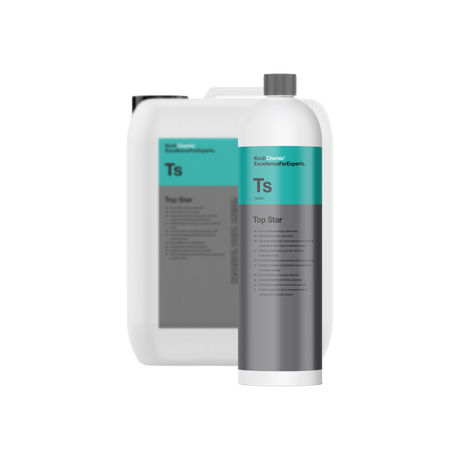
For the pre-wash beforehand, a touchless round with the Koch-Chemie Gentle Snow Foam „Gsf" Reinigungsschaum fits nicely. The pH-neutral foam rinses off loose dust and pollen before a cloth ever touches the paint, and it leaves wax and coating alone. That way the tar remover only meets the genuinely stubborn deposits, not a whole week of dust.
It pays to be disciplined with the cloth. Take a soft, clean microfibre and fold it into quarters, so you have eight fresh faces. A new fold for every tar spot you lift, so you do not drag the sticky mass back onto the paint. One cloth handles a whole car that way, without you finishing up on a smeared corner. Afterwards it goes in the wash separately, because solvent traces otherwise transfer into other cloths.

Tar spots, bitumen, tree sap and glue residue in one product
The strength of the Q²M Tar is its broad reach. One product covers tar spots after a motorway run, bitumen off fresh tarmac, tree sap from the summer car park and glue residue from removed stickers.
That really matters in summer. Heat softens the road surface, fine bitumen droplets patch themselves onto sills and lower door edges, and the trees give off more sap than the rest of the year. Searches for lifting tree sap are climbing noticeably right now and heading for their yearly peak in August. That is exactly the stretch when paint collects the toughest organic deposits.
With tree sap, speed counts. Fresh sap is still soft and gives up quickly. Leave it sitting and it hardens and etches into the clear coat within roughly 48 hours, because the resin acids attack the top layer of paint. Deal with the mark the same day with the solvent and it comes off without a trace. Wait two weeks and you will often see a dull shadow afterwards that only a polish brings back.
Glue residue is a grateful case too. After a peeled-off parking permit or a registration sticker, a sticky film stays behind that grabs dust and goes dark. The solvent softens the glue and the grey edge disappears, without you having to get anywhere near the paint with a fingernail or a blade.
A typical summer scenario shows how the work adds up. After a long motorway run the tar spots almost always sit in the same places — the lower door edges, behind the arches and on the bumper, where the tyre flings the soft surface up. Without a solvent you scrub every single spot and risk fine scratches. With the Q²M Tar you spray the zone once, wait, wipe, and the whole lot is done in a few minutes.
What the Q²M Tar does not lift, and why that is a good thing
The tar remover lifts organic, oily deposits. Iron fallout — embedded iron particles — is not one of them and needs a different active.
That is no weakness, it is clean division of labour. Iron is a mineral solid, not an oily film, and a solvent has nothing to grab onto there. For the iron half of decontamination there are acid-free iron removers like the D-CON „Light" Pre-Cleaner & De-Ironizer Flugrostentferner. Its active binds the iron particles and makes them water-soluble, which you see in the typical purple-red bleed as the bound rust runs off. Two products, two chemistries, one clean paint.
Firmly hooked, non-sticky particles like industrial fallout or baked-on overspray are not a job for the solvent alone either. Whatever does not come off completely by chemistry, you smooth afterwards with a Koch-Chemie Reinigungsknete „Rkb" Mild „Blau" Clay Bar. The clay pulls the last raised bits out of the paint and leaves it mirror-smooth.
And one point on the substrate: the solvent is formulated to be paint-safe and, used properly, is also safe on coatings and sealants. It does degrease the surface thoroughly, though. Seal fresh straight afterwards and you are working on a perfectly prepped, oil- and wax-free surface, which is all to the sealant's benefit.

When solvent, when acid, when clay
The three decontamination steps mesh together, and each one solves exactly one problem. A quick signpost makes the choice obvious.
If you see black, sticky or oily dots that feel smeary, that is tar, bitumen or glue. Then you reach for the solvent, the GYEON Q²M Tar. If the paint feels rough under the wash mitt and, looking closely, you can make out tiny orange-brown dots, that is iron fallout. Then the acid chemistry of the iron remover does the work. If the surface still is not silky-smooth after both steps, the clay comes in as the mechanical fine-finish.
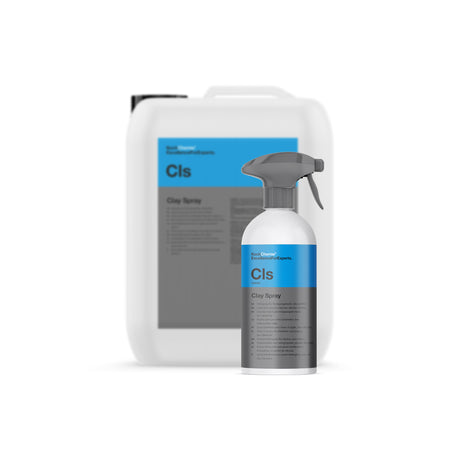
The order is no accident. First you wash, then you lift the sticky deposits with the tar remover, then the iron remover dissolves the fallout, and right at the end the clay smooths the rest. Clay before the tar and resin are gone and you just spread the sticky mass over the whole panel and smear the lube. For the clay itself, always plenty of glide film, say with the Koch-Chemie Clay Spray „Cls" Reinigungsknete Gleitspray, so the clay floats instead of grabbing.
That division of labour saves time in the end and spares the paint. Each step only lifts what it was built for, so it runs fast and without any muscle. The mistake we see most often is trying to bludgeon everything with a single all-purpose cleaner and plenty of elbow grease. The result is swirls in the clear coat and a surface that looks clean but shows a web of fine scratches under raking light. Three matching products in the right order finish quicker than one wrong one at twice the effort.
For the overview of both chemistries, it is worth a look at our iron removers and our paint prep. How the three steps play together in detail is laid out in our guide to proper decontamination of iron fallout, tar and tree sap, and the finer points of clay are in the piece on clay bars for your car.
Who the tar remover is worth reaching for
A resin and tar remover belongs on every shelf where the paint gets more than just a wash. If you regularly have to get tar off the car and lift resin marks whenever you polish, seal or maintain a coating, sticky decontamination is a must, because otherwise every protective film sits on top of a deposit.
For the high-mileage driver racking up motorway kilometres every week, tar is a constant. For anyone parking under trees in summer, it is the sap. Both gain from one product covering the whole oily-sticky range, instead of buying a specialist for every mark. On bottle size, let your frequency guide you. The 500-millilitre bottle lasts a whole season of occasional spot treatments, the 1000-millilitre bottle is the pick if you are regularly decontaminating whole cars.
If you only wash now and then and do not build the paint up any further, you will go a long time without one. But the moment a single stubborn tar spot or a drop of sap spoils the freshly washed look, reaching for the solvent is the only right answer that will not put the paint at risk. Rubbing is not an option — it costs you swirls. And an opened bottle keeps on the shelf across several seasons no problem, because you only use it spot by spot, not over whole panels.
In the end the Q²M Tar is the product for the moment when the wash is basically done and something still sticks. That last touch is exactly what decides whether the paint just looks clean or feels clean too.

Detailing1-Insight: From our day-to-day, the most important thing with a tar remover is temperature, not quantity. We always lay the Q²M Tar down on cool, shaded paint and let it stand a good half a minute to a minute before the cloth comes in. In full sun on a hot bonnet the solvent flashes off too fast, and then the tar smears instead of lifting. And one thinking error we see again and again in enquiries: it will not remove iron fallout. That is iron particles, not an oily deposit — they need an acid-free iron remover. Tar and resin first with the solvent, then iron fallout with the iron remover, then clay. In that order no step gets in the next one's way.
No time for the whole post? Get it summarized: