

You can spot genuine leather even when your seat mixes two materials
A short question landed under one of our products the other day: "Does it work on faux leather?" Another one read: "Does it work on Tesla seats?" Both sound trivial. But they show that plenty of drivers don't actually know what's fitted in their car. Configurators talk about leather upholstery, Nappa or vegan leather. Which of that is hide and which is plastic isn't printed on any seat.
You spot genuine leather in a car by three things: an irregular grain, the way it creases when you pinch it, and the trim name. The popular water drop test only tells you whether the surface is open or sealed, not whether there's leather underneath.
Genuine leather is hide, faux leather is coated fabric
Spotting genuine leather starts with the definition, and in Germany that definition is pretty strict. Under RAL 060 A 2 and DIN EN 15987, only a material made from animal hide by tanning, with the natural fibre structure kept intact, may be called leather. Faux leather, by contrast, is a textile backing with a layer of polyurethane or PVC on top.
In a car that clean line gets blurred, because almost every genuine leather carries a plastic layer of its own. Pigmented smooth leather gets a colour coat after tanning plus a clear top layer, the topcoat. That layer is usually 10 to 30 micrometres thick, and the standard allows 0.15 millimetres at most in total. Anything thicker and the material is called coated leather, and only as long as the coating makes up no more than a third of the total thickness.
What that means for you: run a finger over either material and you feel a smooth, closed plastic surface. The difference sits underneath. With leather, a fibre network of hide carries the coating; with faux leather, it's a woven or non-woven fabric. That's exactly why the two behave differently when they flex, as they age and when you clean them, even if they look identical when new.
One industry figure shows how common that closed surface is: roughly 90 to 95 per cent of the genuine leather in modern production cars is pigmented and sealed. Open-pore aniline is the exception. Faux leather ages differently, because its plasticisers escape over the years through UV light and heat. The material then goes hard and develops fine cracks, long before well-kept leather shows any trouble.
The names follow rules too. "Kunstleder" (artificial leather) is an accepted term in German, while labels like "PU leather" or "textile leather" are not, according to the naming rules of the German Leather Federation (VDL). So if a spec sheet says "vegan leather", you're almost always looking at faux leather, and that's no knock on it. Modern faux leather is hard-wearing, easy to look after and a deliberate choice of surface in plenty of new cars.
Leather upholstery is rarely one material from end to end
Many leather packages only use real leather where your body touches the seat, meaning the centre panel and the inner bolsters. Headrests, seat backs and the hard-working outer bolsters are then often faux leather. That's standard practice in the industry, not a defect.
DIN EN 16223 sets out how leather in upholstered furniture and car interiors has to be labelled. In practice, though, ticking "leather" in the configurator still doesn't mean every square centimetre is hide. So the same seat has two materials with two different care needs sitting right next to each other, separated by nothing more than a seam.
The trim name gives you your first clue before you run a single test. BMW Sensatec and Veganza are faux leather, Vernasca and Merino are genuine leather. Mercedes-Benz ARTICO and MB-Tex are faux leather. Tesla goes with synthetic covers marketed as vegan. You'll find the name in your purchase contract, the equipment list or the configurator for your model.
With that first hunch in hand, you check three spots on the seat itself: the centre panel, the outer bolster and the back of the seat. If two of them feel different, crease differently or show a different grain, you've got a mixed seat. That's the most common answer to whether a car seat is leather or faux leather: it's both.

The water drop separates open from sealed, not real from fake
A single drop of water tells you within a minute whether a surface is open-pored or carries a closed topcoat, but not whether there's leather underneath. Pigmented smooth leather and faux leather both leave the drop sitting on top, because in both cases there's plastic on the surface.
If the drop soaks in within 30 to 60 seconds and leaves a dark mark, you're looking at open-pore aniline or semi-aniline leather. These leathers are only lightly dyed through and carry next to no protection. You tend to find them in luxury cars and in classics like the ones lined up at Techno Classica in Dortmund these days. Nubuck and suede soak up water too, but you'll know them straight away by their velvety feel.
For cleaning, the drop test is still the most important step, because it decides which cleaner you use. Open-pore leather can't take wet cleaning; sealed surfaces can. Do the test somewhere hidden, such as low down on the seat bolster, with a single drop of clean water, then dab it off with a dry microfibre cloth.
High-wear spots are a special case. Where the topcoat has worn through after years of getting in and out, even pigmented leather can absorb the drop. Test only there and you might mistake coated leather for aniline. That's why the drop always goes on a protected area that barely touches jeans and back pockets.
Grain and creasing give the hide away
Whether there's hide under that smooth surface shows in the grain and the creasing, because industry can only copy both up to a point. Genuine leather has irregularly spaced pores of different sizes; faux leather has an embossed pattern that repeats at even intervals.
The easiest way to see it is with your phone's macro mode. Photograph two spots on the centre panel about a hand's width apart and compare them. If the grain looks stamped on in both, it's probably faux leather. If it shows small irregularities, fine lines and tighter or looser zones, that points to hide.
The second test needs nothing but your thumb and forefinger. Gently pinch the surface on the centre panel, about two centimetres wide. Genuine leather throws fine, irregular wrinkles that smooth out again straight away. Faux leather forms sharper, harder creases in a straight line, and the embossed pattern visibly distorts with it.
Both tests have limits, and you should know them. Faux leather in newer luxury models now gets very irregular embossing, and heavily embossed genuine leather like Vernasca looks almost uniform. If you want to identify genuine leather, never rely on a single test. When the name, the grain and the creasing all point the same way, you can be sure. If they contradict each other, treat that spot as the more delicate material until you know for certain.

Burn tests and nail tests have no place in a car
Plenty of guides online recommend the lighter test or scratching with a fingernail, but in a car both do more damage than they clear up. A flame melts faux leather and scorches the topcoat on real leather, and a scratch stays visible on either material.
The same goes for checking the reverse side. With a bag you just flip the strap over and see fibres or fabric. On a car seat you'd have to undo a cover or open a seam. If you want to spot genuine leather in a car, you can do it without that kind of surgery. It's not worth the hassle when the name, the grain and the creasing already paint a clear picture together.
The most common mistake, though, happens after you've identified the material. Mistake faux leather for the real thing and you'll rub it with a re-oiling leather conditioner. On plastic the conditioner doesn't soak in; it sits there as a greasy film, shines and attracts dust. The other way round, a pure faux leather cleaner leaves drying marks on open-pore aniline that barely ever come out.
Baby wipes and household all-purpose cleaners don't suit either material. They often contain alcohol, fragrance or too high a pH, and they leave a film that only shows up weeks later as a greasy sheen on the centre panel. A mild cleaner matched to the material is gentler and no more work.
The reason is chemistry. During tanning, leather is set to a slightly acidic state, and its pH sits at around 4.5 to 5.5. Many all-purpose cleaners run at pH 10 to 12. In that alkaline range the solution attacks the topcoat and dries out the hide underneath. You only notice months later, when the surface turns dull and hairline cracks appear on the bolsters.
Every material gets its own cleaner
Once you know which material sits where, you clean each zone with the right product and always work through a tool, never spraying straight onto the leather. That way only as much liquid hits the surface as the dirt actually needs.
For pigmented smooth leather, which covers most centre panels, COLOURLOCK "Leather Cleaner" (Mild) 1000 ml / 1 Liter is the right call for everyday grime. Fill it into a Koch-Chemie Foamer Bottle Schaumspender 150ml, put the foam on a soft leather brush and work in small circles. Take off any residue with a slightly damp microfibre cloth. For heavy soiling and the difference between mild and strong, we've written a separate article.
If your drop test turned up open-pore leather, that's where COLOURLOCK "Aniline & Nubuck Cleaner" 1000 ml / 1 Liter comes in. Use it sparingly on a cloth or sponge and go easy on the pressure, so you don't end up with tide marks.
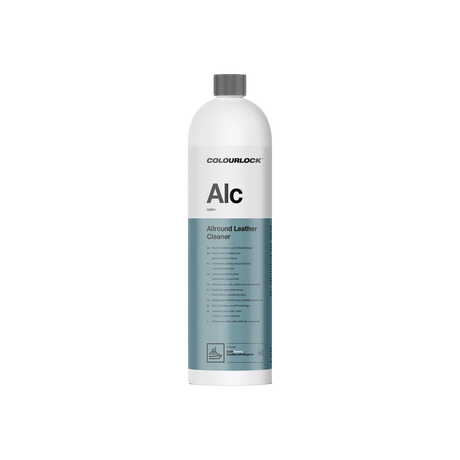
For mixed seats and all-faux-leather surfaces there's an all-rounder. Koch-Chemie Allround Leather Cleaner "Alc" 1000 ml / 1 Liter cleans vinyl, faux leather and genuine leather in one pass and also goes on with a foam bottle. Never use it on hot surfaces and don't let it dry on. On Trusted Shops it has three verified reviews, all five stars.
After cleaning, the paths split for good: genuine smooth leather gets a leather conditioner with UV protection, while faux leather gets a sealant that doesn't grease the surface but protects the plastic layer against abrasion and dye transfer.
For the faux leather areas, meaning bolsters, seat backs and headrests, COLOURLOCK "Artificial Leather Protector" 1000 ml / 1 Liter is the one built for the job. Lay it down thinly with a soft cloth on the clean, dry surface and let it flash off briefly. It forms a flexible, clear film that cuts friction from jeans and clothing without changing the sheen or the feel.
Give the seat enough time to dry after cleaning. Only once the surface is completely dry does the conditioner go on; otherwise the leftover moisture dilutes it and it spreads unevenly. If you're working the seat in zones, clean everything first, then treat zone by zone with the right product.
Alcantara is a special case, and it often sits next to leather in the same seat. It's a microfibre material developed in 1970 for Toray and has nothing to do with animal hide. It needs neither leather cleaner nor faux leather sealant, just its own very dry clean with a soft brush.
You'll find every cleaner and conditioner by leather type in our leather care category. And if you want to go deeper into aniline, semi-aniline and suede, our article on identifying your leather type walks you through the five material classes and their trim names in detail. The most important move is still the simplest one: identify first, then clean, and do it for each zone of the seat separately.

Detailing1-Insight: What we see a lot: someone puts a water drop on the centre panel, it beads up, and they conclude the whole seat is faux leather. Then greasy leather conditioner ends up on the faux leather bolsters and looks smeary a week later. The drop test only tells you whether the surface is open or sealed. So check two spots, the centre panel and the outer bolster, each with the drop and the grain. Two extra minutes at the start save you a film that takes weeks to get rid of.
No time for the whole post? Get it summarized: