

Brown tyres aren't dirt, they're the protection doing its job
You wash the car, the wheels come up gleaming, and two weeks later that reddish-brown haze is back on the sidewall. Most people then lay down another coat of tyre shine and wonder why it comes back faster afterwards. But the haze isn't dirt from outside. It comes out of the tyre itself, and it's the reason the sidewall still has no cracks after five years. Tyre care doesn't start at the bottle, it starts with understanding what you're looking at.
Polymer chemistry calls the browning blooming, and it's the visible trace of an ozone protectant migrating out of the rubber to the surface. You can and should wash it off, just not every week. Clean too often and too hard and you burn through the tyre's protection reserve early.
Late summer pushes blooming to its yearly peak
Ozone, heat and UV are the three engines behind a brown sidewall, and in August all three run flat out at once. In busy urban areas ground-level ozone climbs to 100 to 200 ppb on hot summer days, while a mild winter day sits at a fraction of that.
Heat works on two fronts. It speeds up the reaction at the surface and at the same time widens the molecular gaps in the rubber, so the protectants diffuse outwards faster. A car parked in full sun all summer sweats its protection out visibly faster than one in the shade or under a carport.
That's exactly why tyres often look worse at the end of August than they did in April, even though the car has been washed several times in between. Demand follows the same rhythm: German search data shows "tyre care" flat at zero measurable interest for nine weeks, then climbing three weeks in a row. The second yearly peak lands in October and November, right on the seasonal wheel swap.
How sensitive rubber is to ozone shows up in the test standards. ISO 1431 and ASTM D1149 expose samples to 50 pphm of ozone at 40 °C for 24 to 168 hours, which is 500 ppb and two to five times a hot summer day. Unprotected natural rubber under tension, though, starts forming microscopic cracks from about 30 ppb. There's less distance between "outside in daily use" and "lab hell" than the words test standard suggest.
There's a practical reason to do it this week, too. Today it's overcast and dry here in Nordhorn, with rain from Friday. If you were going to do the sidewalls properly anyway, the dry window is now, not at the weekend. A tyre dressing needs dry rubber to cure, and wet rubber won't take a polymer.
6PPD migrates outwards, oxidises and turns brown
A tyre sidewall carries between 3 and 7 parts per hundred rubber of 6PPD, an antiozonant that is deliberately not locked into the vulcanised network. It has to stay mobile. When ozone hits the surface, this molecule reacts millions of times faster than the double bonds in the rubber and sacrifices itself in their place.
Put simply: the tyre has a chemical sacrificial anode built in, the same way a boiler has a magnesium rod that corrodes so the tank doesn't. As the 6PPD at the surface gets used up, a concentration gradient forms towards the inside of the tyre and fresh material moves out to replace it. That resupply is the blooming. Here's what it means for you: as long as your sidewall goes brown, the defence is working.
The colour only appears in the second step. The originally grey-black 6PPD oxidises at the surface into 6PPD-quinone, and that breakdown product carries a ring structure that absorbs light heavily. Out of that comes the typical dark brown to reddish-brown tone.
Why you only see it on the sidewall and never on the tread comes down to mechanics. The tread contains exactly the same 6PPD, but there the tarmac sands the brown residue off continuously before it ever becomes visible. Nothing rubs the sidewall, so the layer builds up undisturbed over weeks.
That also explains why a car with lots of miles blooms harder than one that sits. The flexing of the sidewall on every wheel revolution acts like a molecular pump and drives protectants outwards on top of the normal diffusion. After a long motorway run in the heat the effect is at its most obvious.
The flip side hits stored cars. Park a car over winter and that pump is gone entirely. The 6PPD at the surface eventually reacts away completely, and without the flexing almost nothing moves up from the deeper layers. All that's left is the second line of defence, the paraffin and microcrystalline waxes that block ozone purely physically. So taking a stored car out for a warm-up run every few weeks isn't superstition, it's resupply for the sidewall.
And yes, the black look itself is chemistry too: 30 to 50 phr of carbon black sit in the compound, less for appearance than for reinforcement and as a UV absorber. When a tyre goes ash grey, you're not looking at faded colour, you're looking at a matrix that this carbon black is escaping from.

Brown, white and ash grey are three different diagnoses
Before you reach for any bottle, it's worth a look from half a metre back. The sidewall shows three appearances that behave completely differently in chemical terms, and that therefore get handled differently.
Brown to reddish-brown is the antiozonant blooming described above, and it's the good case. The layer is dead, it's already sacrificed material, and it can go. A whitish, milky, dusty haze comes instead from the paraffin and microcrystalline waxes blended into the tyre as a second, purely physical ozone barrier. They crystallise out at the surface and form a film you'll spot most clearly on a car that has stood for a long time. That's harmless too.
The third diagnosis is the serious one. Ash grey, dry and with fine crazing means the internal protection system is spent. Ozone then attacks the bare rubber directly, the polymer chains break, and the embedded carbon black that gives the tyre its blackness weathers out of the destroyed matrix.
Unlike blooming, this state is irreversible. No cleaner and no dressing brings it back, and from here the tyre is a safety topic rather than a cosmetic one. Covering ash-grey crazing with yet more dressing only buys time on the one component that connects your car to the road. So two of the three diagnoses call for a brush, the third calls for an appointment at the tyre shop.
Dissolve with alkaline, lift with mechanics, until the foam stays white
Car shampoo reliably fails against heavy blooming, and that's not down to the scrubbing, it's down to solubility. 6PPD-quinone is essentially insoluble in water and strongly lipophilic, it would rather bind to organic structures than to water. A pH-neutral shampoo with mild surfactants has no leverage on that.
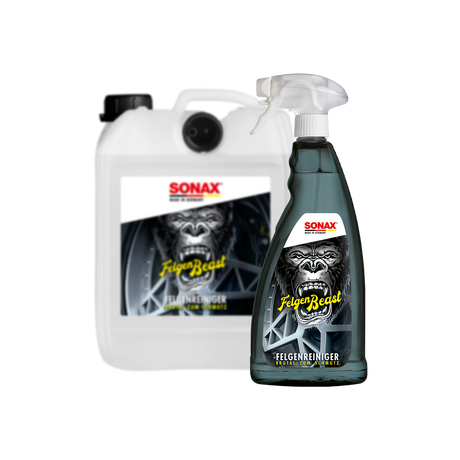
What works is the alkaline range. Hydroxide ions saponify the organic residues, and the surfactants encapsulate the dissolved molecules in micelles so they can be rinsed off at all. The SONAX XTREME Reifen+KunststoffReiniger 750 ml sits at pH 10 to 11 according to its safety data sheet and is built as an aqueous surfactant solution with alkyl polyglucosides. That corridor is exactly right here.
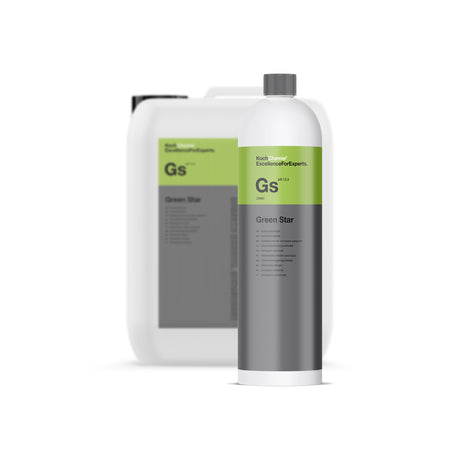
A long way from it are the pH 12.5 to 13 of a pro concentrate like the Koch-Chemie Green Star "Gs". We recommend that one for engine bays and floors, not for the weekly tyre round. More caustic doesn't lift more bloom here, it just costs you more of the protection reserve.
Acidic wheel cleaners are the wrong tool for this job. They're strong against inorganic soiling like baked-on brake dust and iron fallout, and we broke down which pH plays which role at the wheel in our guide to wheel cleaners. Against an organic quinone and wax layer on rubber they do nothing, and with longer dwell times strong acids also attack plasticisers and rubber valves.
You still can't skip the mechanics. The sidewall is microporous and carries ribbing, DOT codes and raised lettering that the softened material sits in. Spraying and rinsing touchlessly gets you nowhere. The GYEON Q²M TireBrush has stiff but material-safe bristles for exactly this and pulls old dressing residue out of the structure alongside the bloom.
In the process, order decides everything. Cleaner goes onto a dry or at most slightly damp tyre, not a wet one: a wet tyre dilutes the product instantly and you're working at half strength from the first pull of the trigger. For this job you dilute concentrates somewhere between 1:3 and 1:5, ready-to-use tyre cleaners go on neat.
Dwell time sits between 20 seconds and a maximum of two minutes depending on temperature. Nothing may dry on, and that's not a formality: in the sun or on a hot tyre the water flashes off, the caustic concentration at the surface shoots up and leaves marks on rubber and wheel that never wash out again. So shade, a cooled wheel, and two short passes rather than one long one.
The best progress indicator costs nothing. As you scrub, the white foam turns brown or yellowish straight away, and that's the dissolved quinone. You repeat spray, brush and rinse until the foam stays white. On a tyre that has only been washed along with the car for a season, that's realistically three to five passes. The sidewall then looks matt and dull at first, and that's exactly right: bare, degreased rubber.
Work your way round the tyre a quarter at a time rather than spraying the whole thing and then brushing. Spray a quarter, work it with pressure, move on to the next. That way no section stands long enough to dry on, and you see per quarter whether the foam is still discolouring. Ease off the pressure at the wheel edge, no mechanics needed there.
On the home remedies people ask about most online, an honest read: washing-up liquid does degrease, but it's unspecific and at around pH 7 far too weak for quinone. Oil, petroleum jelly or hardware-store silicone spray darken the sidewall briefly, stay greasy and then hold onto every bit of brake dust. Trying one once is no disaster, as a routine they're the most expensive option.

Degreasing too often costs you years of tyre life
This is where the usual advice flips. The amount of 6PPD in the tyre is finite at 3 to 7 phr and fixed when it's built, you can't top it up. Go over the sidewall weekly with harsh degreasers or solvent-based products and you don't just strip the antiozonant at the surface, you permanently accelerate its migration from within.
The reserve then empties years before the mechanical wear limit. What follows is the third diagnosis from above: ash grey, dry, crazed, on a tyre with plenty of tread left. Continental explicitly warns in its technical bulletins against petrochemical solvents on tyres, because they wash out the protective waxes and antiozonants and can penetrate into deeper layers.
The industry says itself that it has no room to move here. The US tyre association USTMA, whose members include Bridgestone, Continental, Goodyear, Michelin and Pirelli, states that there is currently no commercially available alternative to 6PPD with comparable protection. That's why it's in practically every road tyre. Anyone who wants a permanently bloom-free tyre is effectively asking for less ozone protection.
That also answers one of the most searched questions on the topic: tyre care against cracks doesn't exist. A dressing lays a UV barrier on top and slows further degradation, but a crack is a broken polymer chain. It doesn't grow back together. Care is prevention, not repair.
In practice that means the hard deep clean with brush and alkaline cleaner belongs on a two to three month cycle, ideally tied to the seasonal wheel swap. In between, a normal wash with shampoo and a mitt is enough to take off loose road grime and brake dust before the heat of the brakes bakes it in.
Two more mistakes we see over and over. The first is dressing on an uncleaned or damp tyre: the old quinone and silicone layer acts as a release agent, the new product doesn't bond and flies off as tyre sling onto your freshly polished wing at the first wheel revolution.
The second is product on the tread. Both silicone and water-based compounds noticeably lower the friction coefficient on tarmac, and that's a crash risk on a bike and a braking-distance issue in a car. If something lands there by accident, wash it off with washing-up liquid and hot water before the vehicle moves.
Water-based keeps the haze away longer than silicone
After cleaning, the sidewall is open and unprotected, and the choice of dressing decides how quickly the brown comes back. The line you'll read on forums, that silicone causes blooming, isn't chemically true. Silicone doesn't oxidise 6PPD. The effect is a different one and real all the same.
Solvent-based silicone oils like polydimethylsiloxane are too big to penetrate, so they form a film on the surface instead, and that film never fully cures. It stays tacky, and on a tacky sidewall every bit of brake dust, sand and road grime sticks. The tyre then doesn't go brown from the inside, it's simply loaded up from the outside. To the eye both look identical, which is why the myth is so persistent.
Water-based polymer and acrylate emulsions work the other way round. They pull into the micropores, the water evaporates, and the polymers cross-link into a dry, non-tacky layer with a satin to matt finish. The GYEON Q²M TireExpress 500 ml is built that way and runs three to four weeks without streaking.
If you weight UV and ozone protection higher than the finish, the Dr. Wack P21S "Reifen-Glanz" 400 ml serves you well, and one can covers up to 35 tyres according to the maker. Whether your sidewall ends up satin or high gloss is a matter of taste, which we took apart yesterday in our comparison of the two finish camps. The full range sits in the tyre care category.
When you lay it down, thin and even with an applicator beats generous straight from the bottle. After five to fifteen minutes you go over the sidewall once with a dry microfibre and take off the excess that would otherwise end up on your paint later. Then the car stands for at least ten to thirty minutes, better overnight, before it sees the motorway again.

Detailing1's tip from the shop: We've got into the habit of tying the tyre round to the wheel swap rather than to the wash. Twice a year, take the sidewall through with brush and alkaline cleaner until the foam stays white, then seal it water-based, and in between nothing but shampoo. That sounds like less care than most people expect, and that's exactly the point: the most expensive mistake on a tyre sidewall isn't neglect, it's overzealousness. A tyre that's still supple at eight years old has spread its 6PPD over eight years instead of having it washed out in two seasons.
No time for the whole post? Get it summarized: