

A wash-and-wax shampoo is a booster, not a wax replacement
The bottle shouts "2-in-1 — cleaning and sealing in one step". The idea is simple: wash once, and your paint comes out clean and protected against water, salt and bird droppings at the same time. Use it once, see the gloss, feel how slick the panel is, and you start wondering: why bother laying down wax at all? The answer isn't in the marketing — it's in the chemistry of the layer the shampoo leaves behind.
A wash-and-wax shampoo gives you two to six weeks of protection per wash, which covers exactly one to three regular wash cycles. It's a strong booster for the wash and an ideal top-up for coatings, but it replaces neither a hard wax nor a spray sealant. This guide shows you how the chemistry works, the five mistakes that wreck the layer, and which product from our range suits which paint.
Three types of shampoo, three levels of protection
Car shampoos fall into roughly three camps: the pure cleaning shampoo, the wash-and-wax shampoo with a sealant, and the reactivating shampoo for dirty coatings. Each one tackles a different job, and none of them stands in for another.
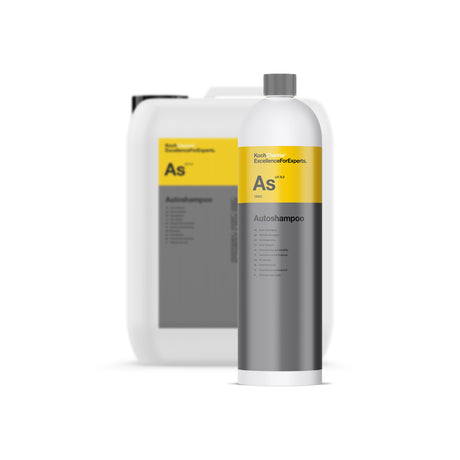
A pure cleaning shampoo like the Koch-Chemie Autoshampoo As is built for one thing: pulling dirt off the paint. No gloss or protection additives, phosphate- and NTA-free, and it leaves a completely clean, degreased surface. That's exactly what you want before you polish, wax or coat — any extra layer just gets in the way of the next step.
A wash-and-wax shampoo like the Ceramic Effect Shampoo does a second job on the side. While the surfactants lift dirt, silicon-based polymers settle onto the cleaned paint at the same time. The result: rinse it off and the water beads straight away, and the panel feels glass-slick. That layer only lasts as long as rain drives, road salt or the next wash don't strip it back off, though.
The third type, the reactivating shampoo, comes out when an existing coating has lost its beading. Here mild acids clean mineral deposits out of the coating's pores instead of laying down a new layer. That type sits outside today's topic, but it's worth knowing about — because a wash-and-wax shampoo on a limescaled coating does more harm than good. We'll get to that later.
The chemistry behind the booster: why the layer forms in the first place
The interesting question with any wash-and-wax shampoo is a physical one: how does the protection get from the bucket onto the paint without being rinsed straight back off? The answer is a mechanism called coacervation, and it runs on electrostatics.
Modern premium shampoos carry two groups of active ingredients: first, functionalised siloxanes and amorphous silicon dioxide as the actual protective component; second, cationic polymers such as guar hydroxypropyltrimonium chloride or cationic hydroxyethyl cellulose as the delivery system. The cationic polymers team up with the surfactants to form micellar nanocomplexes — so-called coacervates — and wrap the hydrophobic SiO₂ particles inside them. As long as the shampoo sits in the wash bucket, that system stays stable and ready to travel.
The moment the solution hits the paint, stage two kicks in: after cleaning, the clear coat carries a slightly negative surface charge, and the cationic complexes are positive. They latch onto the surface electrostatically, release the SiO₂ particles and siloxanes right there, and when you do the final rinse with clean water it's not the protective particles that wash away — only the spent surfactant residue. The silanols that form out of the siloxanes then cross-link with the paint surface into a thin Si-O-Si layer.
The Koch-Chemie Ceramic Effect Shampoo actually goes a step further and throws epoxide components into the mix as well, flagged by the EUH205 note on the label. These epoxides cross-link covalently with the paint surface and boost its resistance to follow-up alkaline attack — a detail that's rare in this price bracket, and one that makes wearing nitrile gloves a sensible move.
What the layer lasts: two to six weeks, no more
Once you know how long each level of protection holds, the right product choice almost makes itself. A wash-and-wax shampoo gives you two to six weeks of protection in real use, which works out to about one to three regular wash cycles. First-hand reports from the Fahrzeugpflegeforum and Cleanstuff back up that range consistently.
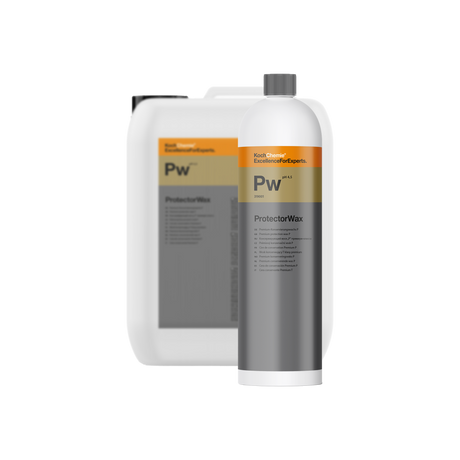
A dedicated wet coat sealant like the Koch-Chemie Protector-Wax plays in a higher league. Because it doesn't have to compete with cleaning surfactants, it can build a much denser layer — about 30 millilitres to a litre of water, sprayed onto the wet paint through the foam lance and rinsed off after a moment. Lifespan: four to eight weeks. The slickness underhand and the way water sheets off are well ahead of the shampoo.
A classic hard wax, carnauba or synthetic, manages six to twelve weeks with proper prep, and a real ceramic coating twelve to sixty months. The ladder is clear: wash-and-wax shampoo is the bottom rung, a coating the top. Try to replace an 800-euro coating with wash-and-wax and you'll be let down. Keep your already-coated car fresh week to week and you've got exactly the right tool in hand. We go deeper into the spray sealant spectrum in its own guide.
The five mistakes that wreck any layer
The chemistry of a wash-and-wax shampoo is delicate, and that's exactly where most of the trouble shows up. Five mistakes come up again and again in every forum thread about wash-and-wax products.
First, overdosing. Go by the dose for a normal shampoo and you'll tip too much concentrate into the bucket before you know it. The oversaturated polymers break out of the emulsion, drop onto the paint as a waxy smeary film, and won't rinse off cleanly even with the pressure washer.
You then rub with pressure while drying and put swirls into the paint during a step that's meant to be gentle on it. Koch-Chemie specs the Ceramic Effect Shampoo at 1:200 — that's 50 millilitres to a 10-litre bucket. Stick to that and you've already cut half the risk.
Second, direct sun and hot paint. The watery carrier phase flashes off a heated body panel in seconds, the silanols and leftover epoxides cure uncontrolled, and they burn into the clear coat as white water spots. More often than not those spots only come out again with a polish. That's why makers quote a working temperature of 18 to 25 degrees, and parking in the shade is a must.
Third, paint that's too cold. Near freezing, the siloxanes simply stop cross-linking — the chemistry doesn't run. The layer forms visually, but it barely lasts a week. In the shoulder seasons it pays to glance at the thermometer before you unpack the wash-and-wax shampoo. Working below ten degrees, you're better off with a classic cleaning shampoo and sealing separately later, once your garage has warmed up.
Fourth, skipping the pre-wash. Leave out a touchless pre-wash step with the Gentle Snow Foam and go straight over pollen-, salt- or brake-dust-covered panels with your wash mitt, and you grind the coarse grit into the paint. Even the best wash-and-wax shampoo can't make up for a pre-wash you didn't do.
Fifth, wash-and-wax shampoo on a limescaled coating. When an existing ceramic coating has lost its beading to limescale and road salt, the wash-and-wax shampoo lays yet another SiO₂ layer over the mineral residue and seals the problem in. The only fix here is an acidic reactivating shampoo that dissolves the minerals out of the coating's pores before the wash-and-wax goes anywhere near it.

Our range: three wash strategies from the Koch-Chemie system
Detailing1 stocks the full Koch-Chemie wash line-up, because the brand is built modular and each type solves a different problem. Once the system clicks, you pick by the job in front of you, not by the marketing promise.
The Ceramic Effect Shampoo is the flagship for the regular maintenance wash. pH 6.0, dilution 1:200, and a litre stretches to twenty or thirty washes. The beading after the first wash is round and sharp-edged, and the slickness is easy to feel.
Paired with a shady spot to park and clean wash water, it's our pick for anyone keeping a tidy daily driver on a four-to-six-week wash rhythm. First time out, start deliberately at the low end of the dose and see for yourself how little concentrate already does the whole job.
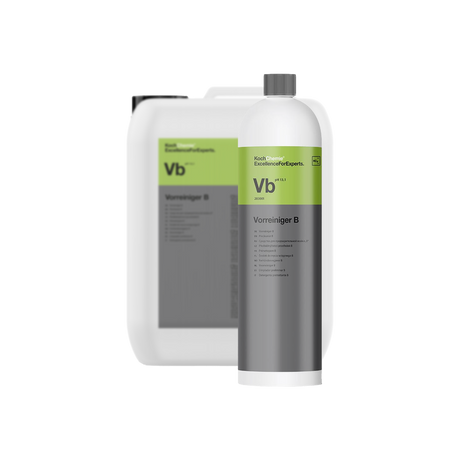
The Koch-Chemie Autoshampoo As stays the tool for a no-compromise deep clean. Heading into a polish, a coating application or a chemical decon, you don't want any sealant residue on the paint — it would clog your polishing pads or spoil the bond of the next layer. Here the As is the clean base, ideally paired with the two-bucket method.
The Protector-Wax Pw comes into play the moment a wash-and-wax shampoo's lifespan no longer cuts it and you want dedicated protection. Spray it on through the foam lance, let it dwell a moment, rinse, and the paint is sealed for four to eight weeks. It's the simplest form of a real wet coat sealant and a good partner to the wash-and-wax shampoo: the shampoo keeps the layer fresh between Pw applications.
For the pre-wash step beforehand we recommend the Gentle Snow Foam Gsf. Sprayed on through the lance, it leaves the paint sitting under foam for ten minutes and lifts the coarse dirt before your wash mitt even goes in the bucket. Do that and you're protecting your wash-and-wax shampoo automatically — the main wash is left with nothing but the fine-dust remainder to deal with.
Detailing1 insight: what we see day-to-day is customers dosing a wash-and-wax shampoo too heavily and ending up with a sticky, waxy film smeared across the paint. Dry that with any pressure and you hand yourself swirls in a step that's supposed to relax the paint. Our advice: read the dose off the label, and go light your first time. 50 millilitres in 10 litres sounds like nothing, but it's plenty for a whole mid-size body.
Which shampoo for which paint — the honest recommendation
Three scenarios cover almost the whole of everyday detailing. Find yourself in one of them and you've made the product call in two minutes.
If your car carries no coating and no fresh wax and you wash it every one to two weeks: the Ceramic Effect Shampoo is the right call. Every wash lays a fresh sacrificial layer on the paint, guards against road salt and mild grime between wash days, and you've knocked out cleaning and basic protection in one step. Keep to the 1:200 dilution, work in the shade, dry off cleanly with a drying towel, done.
If your car already carries a hard wax or a coating and you want to keep it up regularly: the Ceramic Effect Shampoo is still the right call, only here it's not the primary protection but a maintenance tool. It settles into the microscopic gaps in the coating and reactivates the base layer's hydrophobic behaviour. Just watch that the sealant isn't clogged — if the beading was already weak before the wash, what you need first is a reactivating shampoo, not a wash-and-wax on top.
If your car is heading into a polish, decon or coating application: the Koch-Chemie Autoshampoo is the only right call. No sealant residue, no clogged pads, no compromised coating build. Here the deep clean is the goal, not the gloss that follows — that comes from the work afterwards. Reach for a wash-and-wax before machine polishing anyway and you'll be cursing clogged pads and uneven cut later on.
A quick rule of thumb to take away: the wash-and-wax shampoo is the bottom tier of a protection pyramid, the spray wax the middle, the hard wax or the coating the top. Know all three tiers and combine them right, and you get noticeably more protection for less effort — which is the whole point of a range that's been thought through. That's when washing stops feeling like a chore and turns into the step that keeps your protection fresh.
Want to go deeper? There are matching reads on the neighbouring topics over on Detailing101. For choosing your base shampoo, the article How to choose a car shampoo: pH value and coating compatibility walks through the main levers. For snow foam versus all-purpose cleaner, the piece Snow Foam Gsf vs. APC Green Star gives you the practical answer, and on the question of lasting sealing it's worth a look at the spray sealant category guide.
No time for the whole post? Get it summarized: